
Take Five: Don't look back. OK, actually, do
You can tell by that apostrophe that I'm not talking Dylan, but rather literally taking a look back at some favorite posts while I'm working abroad: Poetry, classical, rock, photos, and detectives

This is the part you probably don’t read where I explain what “Take Five” is, which is usually a post about five things I spent some time with over the course of the previous week. However, I’m out of the country this week with no real way to create a post, or inclination to do so even if I could. So I thought it might be a good time to do a greatest hits of sorts, re-sharing some items that might warrant another look. The last time I did this was in August, so I used that as my jumping off point. Offered here in chronological order, oldest to newest, are a few things I think you might find of interest. Five of them, in fact.
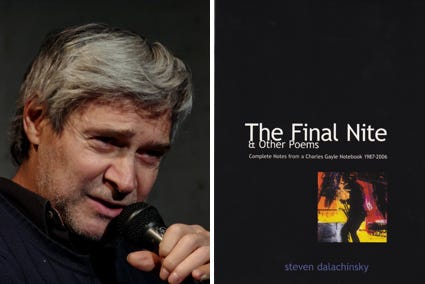
1. Steven Dalachinsky — The Final Nite
First up is a whirlwind that took me through two books and one massive live album this week. I’ve been reading pianist Matthew Shipp’s new collection of writings about jazz, Black Mystery School Pianists. The book is dedicated to, among others, the late New York poet Steven Dalachinsky, and that led me to seek out his work. I found The Final Nite & Other Poems: Complete Notes from a Charles Gayle Notebook 1987-2006. This fascinating collection is exactly as advertised, a gathering of poems written by Dalachinsky while he attended performances by avant garde saxophonist Gayle over the course of nearly 20 years. If there is a book more in my wheelhouse, I haven’t found it.
The poems vary in length, format, and quality. “I’ve included every poem written under these circumstances regardless of whether I thought them successful or not & formatting aside, they are for the most part spontaneous with little or no editing after the fact,” he writes in the introduction. This might seem a red flag, but it works in his favor, for he is responding to music created under similar circumstances: spontaneous, unedited, and not always successful. The poems rarely allude directly to the music; rather, they respond to whatever has captured Dalachinsky’s attention, the thoughts and images conjured by the music and the setting more than the music itself.
I had planned to seek out recordings from some of these specific shows so I could read Dalachinsky’s work while hearing what he heard, and seeing a familiar club name made this an easy task. A quarter of the way through the collection, he shares two poems from a 1991 show featuring Gayle with bassist William Parker and drummer Miford Graves at Webo, a New York music club. I recognized the name and quickly found recordings of that night and the next featuring this powerhouse trio that were finally released last year, so I was able to cue up the music and read the poems. Had I listened to any random trio date featuring Gayle, I likely would have a had a similar response. The verse doesn’t necessarily correspond to anything specific in the playing, but it does fit. Gayle wails, Parker roams, and Graves skitters and drives, the beauty and harmony amid the chaos found in the unexpected moments, and often in the spaces between the notes and beats. Dalachinsky shared two poems from that night, the second of which puts you right there in front of the bandstand:
ok i say ok in the midst of my
delirium & the flan-patterned tile floor
in a mondrian whirlwind of uncomfortability
& soundsheets. ok the saxophonist plays in
front of a little black sign on a big white
wall that says MEN — ok i say
how far we’ve come these past few years
how far back in time
we’ve come.
Posted Aug. 15, 2025
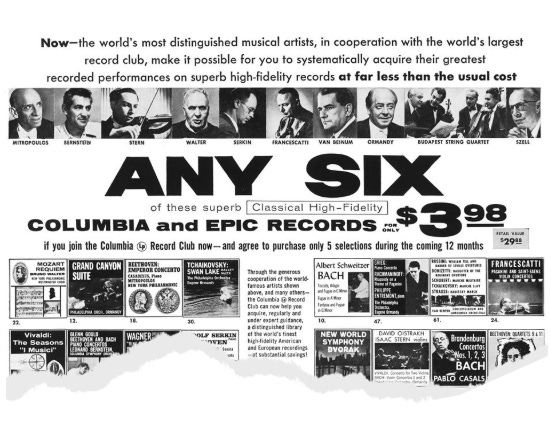
2. Grand Canyon Suite, performed by the Philadelphia Symphony, directed by Eugene Ormandy
Bear with me. I have spent quite a bit of time with the January 1959 issue of Esquire magazine because it is where the “A Great Day in Harlem” photo was first published. It was part of a theme issue on “The Golden Age of Jazz,” and it features interesting features on Duke Ellington, Charlie Parker and others, and writing by the likes of John Clellon Holmes and Ralph Ellison. One thing that caught my eye was an ad for the Columbia Record Club. In my day, you got 12 cassettes for a penny and then kicked yourself for the overpriced tapes you would get because you had been too lazy to say you didn’t want them. In 1959, $3.98 got you six LPs. This was pre-Beatles, pre-rock, etc., so the selections were very different. Oddly enough, given the theme of the issue, there is no jazz. Columbia had released Miles Davis’s Milestones, Billie Holiday’s Lady in Satin, and Duke Ellington’s Newport 1958, among others just before the calendar flipped, but the focus of this ad is on classical music. Which leads me to Grofé’s Grand Canyon Suite, performed by the Philadelphia Symphony, directed by Eugene Ormandy. It is a sometimes soothing, often sweeping cinematic score; a bit soft for my tastes, but it was new to me as opposed to the Vivaldi, Haydn, and Brahms also up for sale, so I gave it a listen. Thinking the typical Esquire reader would be eager to own this, and what he would crave just a year or two later, is a reminder of how quickly things were about to change.
Posted Oct. 24, 2025
3. Leon Russell — ‘Stranger in a Strange Land’
A bit of a rabbit hole turned into a full-blown conspiracy dive this week as the song that played while the credits rolled on the first episode of the FX show “The Lowdown” started to peel like an onion. I Shazamed the song, which sounded somehow new and old at the same time, and found the song “Stranger in a Strange Land” by the band Biniki Robot Army. A bit more digging found that it appeared to be a fairly faithful cover of a song from Leon Russell’s 1971 album Leon Russell and the Shelter People. It seemed a fitting choice from the title alone, all the more so with lyrics like —
Well, I don’t exactly know what’s goin’ on in the world today
I don’t know what there is to say
About the way the people are treating each other – not like brothers
— which could be the sentiments of Ethan Hawke’s character Lee Raybon, a true man out of time who stands up for what’s right, a self-described “truthstorian.”
I dug a bit more into Bikini Robot Army, and found it was a project from the late Val Broeksmit, a troubled musician who was best known as a whistleblower who shared documents that helped to expose money laundering and Trump-Russia connections related to Deutschebank. Suddenly a song that simply sounded good in the moment becomes a metacommentary on the entire premise of the show. Hawke’s Raybon is a used bookseller and an investigative journalist of a sort looking into corruption in Tulsa. It might seem a coincidence in another context, but not in a show helmed by Sterlin Harjo — who works with music supervisor Tiffany Anders — both of whom have made it clear that music is a powerful element in their respective storytelling toolboxes.
But I kept coming back to the fact that I couldn’t hear a bit of difference between the Russell original and this supposed cover. It sounds exactly the same. Broeksmit was known to incorporate samples into his music if you believe what you read, but in this case it would be one gigantic sample that comprised the entire song.
Turns out there is a very simple answer to it all: Shazam — and those writing on a few websites who obviously relied on it — screwed up. So do Apple Music and YouTube, which each wrongly feature Russell’s song on a track credited to Bikini Robot Army. There is indeed a cover of Russell’s song performed by Broeksmit. I finally found that version on Spotify. It’s fine, an unremarkable acoustic version, but nothing compared to the swampy menace of the original, and it is not what comes up when you search for that specific version of the song in any other context.
So, there is no real mystery here. Harjo used Russell’s version, which makes sense given the Tulsa-centric music being used on this Tulsa-set show. And all of those layers, all of that intrigue? Well, unless Harjo and Anders somehow convinced several major media companies to intentionally mislead users, or simply stumbled down the same rabbit hole I did and thought it was a nice Easter egg for viewers, it was nothing more than a coincidence, a quirk of wonky coding pulling the wrong audio. If I ever have the chance to ask Harjo about this and he says he had no idea about any of it, I’ll just say, “It’d be a lot cooler if you did.”1
Posted Nov. 14, 2025
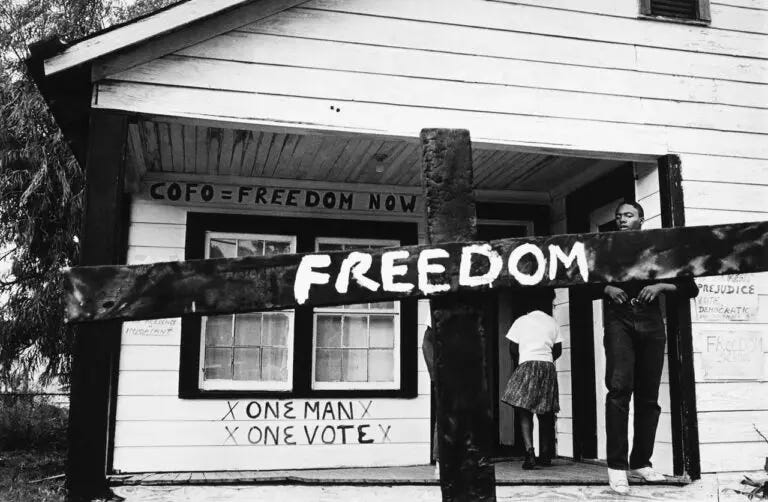
4. Tamio Wakayama —Enemy Alien exhibition
I had to travel to Canada to learn about a Japanese photographer who captured the compelling scenes of the U.S. civil rights movement in the 1960s. “Enemy Alien: Tamio Wakayama,” is an exhibit at the Vancouver Art Gallery that depicts the life of this keen observer, who traveled throughout the American South, Canada, Europe, Cuba and elsewhere, documenting things with his camera. He was declared an “enemy alien” while still a toddler living with his family in Canada as he and his family were moved into an internment camp during World War II. In his 20s, he left British Columbia and drove south to do what he could to help those fighting for civil rights, ending up in Atlanta during Freedom Summer, 1964. While there, he was given a camera at the SNCC office and asked to help to document the struggle. The Vancouver exhibition features much of that work, with arresting images like that above that contextualize the fight for equality, as well as his shots from other stops along his journey. It’s a powerful testament to the value of the unflinching gaze.
Posted Dec. 5, 2025
5. Cole Swensen — ‘Detecting Text’
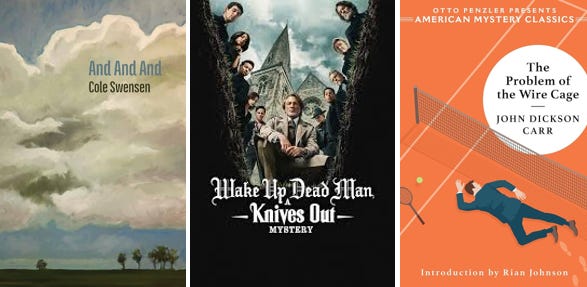
I’ve been reading some classic detective novels thanks to watching (and not terribly caring for) the latest “Knives Out” film, “Wake Up Dead Man.” The story is a classic locked room mystery, and there is much out there about filmmaker Rian Johnson’s affection for the form. That led me to John Dickson Carr’s The Problem of the Wire Cage,2 which, while not a direct inspiration for the film — that would be his The Hollow Man — it is certainly of the same ilk, along with the work of Agatha Christie (who I had never read, however improbably, until tackling The Murder of Roger Ackroyd late last year in a similar “Knives Out”-inspired read). I have read hundreds of mysteries over the years, but my classic reading typically veers toward the more hard-boiled Chandler/Hammett/Cain end of things rather than this fare. I bring all of this up because of a wonderful poem, “Detecting Text,” in Cole Swensen’s latest collection, And And And.3 In it, Swensen notes the tendency of early detective novels to denounce themselves with a sort of “if this were a detective novel” declaration, as if such books are subpar… unlike this book. She then cites several examples, including this from Dickson Carr’s The Mad Hatter Mystery:
“The only thing I regret about the doctor here is the deliberate way he patterns himself after the detectives in sensational fiction.”
About halfway through Wire Cage, the phenomenon appears, as one character says, “If this were a detective story, I’d have suspected myself long ago.” Yes, this is a common occurrence as writers grapple with the oddity of a gumshoe recounting a case in real time.
Posted Jan. 16, 2026
Lost in all of this is the fact that I have had the intention of checking out Leon Russell for years, but never knew where to start. He’s popped up in my explorations of artists like Bob Dylan and Tom Petty, but I had never really listened to his solo work. Once I set all of this investigation aside, I listened to the rest of Leon Russell and the Shelter People (so named because it was issued on Shelter Records, the Tulsa-based label Russell started with Denny Cordell that was the early home to artists like Petty and Dwight Twilley), and found it a good entry point, with solid originals and interesting covers of five Dylan tunes like “It’s a Hard Rain’s a-Gonna Fall” and “It Takes a Lot to Laugh, It Takes a Train to Cry.”
Johnson did write the introduction for this edition of the book.
Note: No commas!